
Beynond Capitalism II
New Left Review, 2025
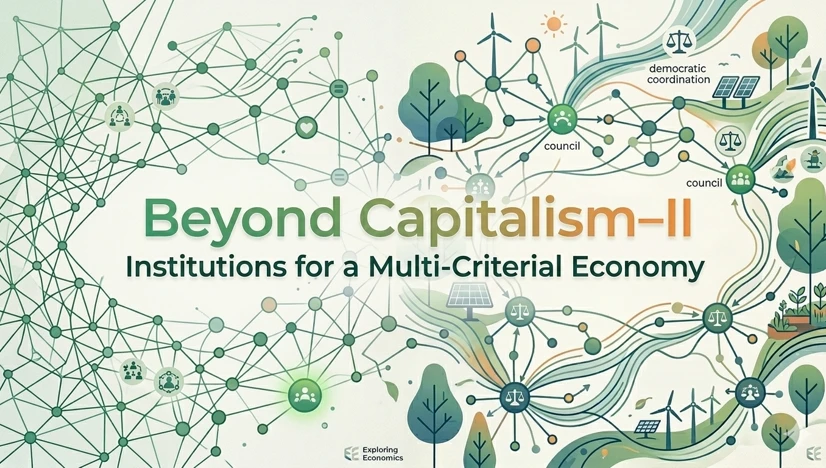
In the concluding part of his essay, Aaron Benanav transitions from theoretical principles to the institutional design of a post-capitalist society. He introduces the concept of a "Socialist Investment Council" as a decentralized, democratic alternative to the market’s blind allocation of resources. Rather than relying on a central planning authority, Benanav envisions a networked system of councils that manage the socialization of investment through transparent, multi-criteria deliberations. This framework aims to decouple social reproduction from the necessity of capital accumulation, allowing communities to collectively determine how to balance ecological limits, social needs, and the reduction of necessary labor time. Ultimately, he argues that the path beyond capitalism lies in creating a socio-economic architecture that treats the economy as a realm of conscious, democratic coordination rather than an autonomous, quasi-natural force.
Comment from our editors:
In this second part, Benanav moves from critique to construction, outlining the concrete institutional mechanisms required for democratic economic planning. His proposal for a decentralized council system is particularly valuable for the contemporary debate as it bypasses the traditional "market vs. state" dichotomy, offering a pluralist vision of economic coordination. By detailing how investment can be socialized without centralizing power, this article serves as a crucial blueprint for imagining a feasible and democratic post-capitalist future.